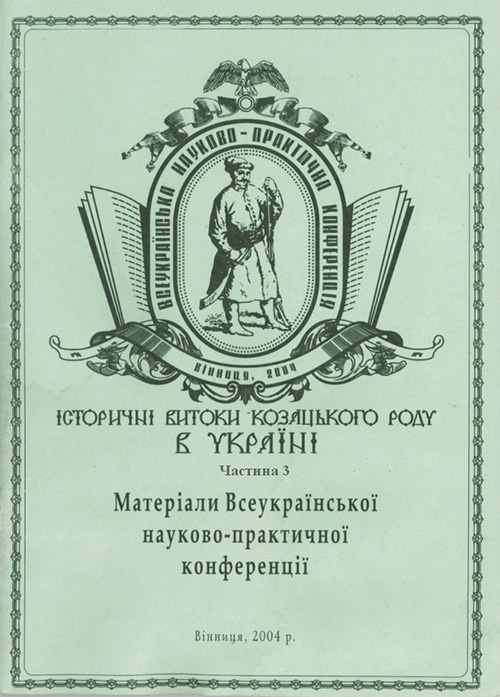
At the conference “Historical Origins of the Cossack Lineage in Ukraine” (Vinnytsia Regional Universal Scientific Library named after K. A. Timiriazev, September 24–27, 2004), around 70 papers were presented, each dedicated to one of the most unique phenomena in Ukrainian history — the Ukrainian Cossacks. The authors included representatives of governmental institutions, historians, literary scholars, local historians, ethnographers, and art historians, as well as lecturers and students of numerous higher and specialized educational institutions, teachers of secondary schools, journalists, library and museum workers, and archivists from Kyiv, Vinnytsia and the Vinnytsia region, Zaporizhzhia, Kharkiv, Odesa, Lutsk, Uman, and Rivne.
The rich and diverse information contained in these materials is systematized into eight thematic sections, each highlighting different aspects of the Cossack movement in Ukraine, including its manifestation in Podillia.
The best papers were published in print, while the full collection of materials was made available in electronic form on the website of the Vinnytsia Regional Universal Scientific Library named after K. A. Timiriazev.
The third section, titled “The Cossacks in Podillia”, features articles that reflect the important historical events of the liberation movement that took place in this region — events that were often both heroic and tragic at the same time.
MAIN HISTORICAL EVENTS OF THE LIBERATION MOVEMENT IN PODILLIA
V. T. Ohorodnyk
In Velychko’s “Chronicles of Events in Southwestern Rus’ in the 17th Century” we read: “Before the Zaporozhian Sich had even arisen there, along the line of Chyhyryn, Cherkasy, Korsun, Kaniv, Bila Tserkva, and Vinnytsia, there already existed Cossack settlements.”
Vinnytsia was a city, while Orativ was a fortified town with a castle-fortress surrounded by ramparts and moats. Along this defensive line, fortification towns were built at that time.
The plow, the spear, the saber, and the horse — such were the tools and companions of Cossack life. They built small towns and outposts, were founders of the first villages, always ready both to till the soil and to defend themselves from raiders. And there were many enemies.
Tatar detachments of three to five thousand horsemen often attacked such settlements unexpectedly, destroying everything around, killing the old, the infirm, and infants, while taking all others captive — binding them with ropes and driving them across the wild steppe to Kaffa (Feodosiya), where their “yasyr” (booty) was sold into slavery. Kaffa was the main slave market.
n our region, Bratslavshchyna, until the 1600s peasants mostly lived in “slobody” — free settlements — and paid their landlords a monetary rent or obrok. Serfdom existed only partially, which is why our land became populated. In 1588, the Polish Sejm granted the nobility the right to execute peasants. Their gradual enslavement began (a peasant who lived on a lord’s land for more than 10 years became his property).
Already by that time, the arbitrariness of magnates and nobles knew no bounds. This gave rise to a whole series of peasant uprisings in which the Cossacks actively participated. One of the first Cossack hetmans, Krzysztof Kosiński, failed to receive from the king a charter granting him the possession of Bila Tserkva, as it had been seized unlawfully by magnate Jan Ostrogski. Because of this, Kosiński raised a Cossack-peasant rebellion.
The rebel units in our region marched throughout the Bratslav Voivodeship, punishing lords, priests, and wealthy Jews of towns, townships, and estates. Later, our compatriots took part in the uprisings led by Taras Tryasylo (Fedorovych), Pavliuk (But), and Yakiv Ostrianytsia (in 1630, 1637, and 1638). In Ostrianytsia’s detachment fought the young Ivan Bohun — our future defender and hero.
At that time, the deputy starosta of Chyhyryn, Chaplynskyi, seized the estate of Bohdan Khmelnytsky, took his wife, and beat his son to death. Such acts of cruelty toward Cossacks and peasants occurred in our land as well. Therefore, it is no surprise that when in May 1648 the National Liberation War of the Ukrainian people against their oppressors broke out, the Cossacks and peasants of our region supported it wholeheartedly.
“God sent to the Ukrainians, as to the Israelites their Moses, a man named Bohdan Khmelnytsky, and gave him strength and wisdom to free the Little Russian people from the heavy Polish yoke and grant them the long-awaited liberty,” — The Chronicle of Samiylo Velychko.
n the history of Ukraine, the figure of the great hetman of the Ukrainian people, Bohdan Khmelnytsky, shines as a star of the first magnitude. He had already visited (more than once) the lands of Podillia and Orativ, as attested by numerous historical documents, complemented by oral accounts, legends, and folk tales.
Here, we must recall the story of the formation of the Zhivotiv Cossack Regiment. At the very beginning of the Liberation War, by order of Bohdan Khmelnytsky, a Cossack army was organized in the southern steppe frontier. Among the first in the Kyiv and Bratslav voivodeships were formed the regiments of Vinnytsia, Bratslav, Bar, Mohyliv, Kalnyk, and Zhivotiv. The regimental town of Stary Zhivotiv was at that time a large settlement of Podillia with a Cossack fortress.
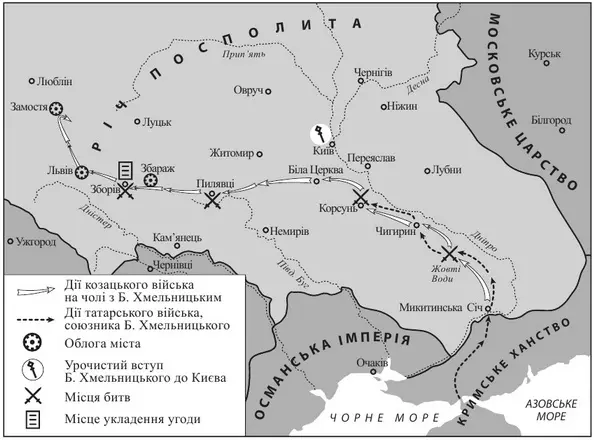
Whether the Hetman himself was present during the regiment’s formation we cannot say for certain, due to lack of documents. However, historical records tell us that in June 1649, while preparing for the siege of Zbarazh (a fortress strongly fortified by the Poles), Bohdan Khmelnytsky led his troops through Stary Zhivotiv.
A concrete story preserved in one of the documents states that in March 1651, Khmelnytsky again visited Zhivotiv, completing there the mobilization of the army for new campaigns. From that time, a legend of “Khmelnytsky’s Oak” has been preserved. It is said that the Hetman, while traveling through the Orativ region, stopped with his retinue near the present-day village of Frontivka. There, at the edge of a forest, stood a majestic oak tree, to which Khmelnytsky’s page tied the Hetman’s horse. This mighty oak still stands today, and is locally known as “Khmelnytsky’s Oak.”
After completing the mobilization in Zhivotiv and its surroundings, in April the Hetman led his Cossack army through Pohrebyshche to Medzhybizh, to take part in the Battle of Berestechko, where he lost it on the battlefield.
But Khmelnytsky was not a man to accept defeat. Less than a year later, in the Battle of Batih (near the village of Chetvertynivka, Trostianets district), the Ukrainian army under his command completely destroyed the fifty-thousand-strong Polish noble army. Everyone traveling from Ladyzhyn to Trostianets, near Chetvertynivka, stops by a granite marker inscribed: „“On this site near Batih in May 1652, the Ukrainian army under the command of Bohdan Khmelnytsky annihilated the Polish-noble invaders. Let us also bow to that Cossack glory.”. Already in June 1652, Bohdan Khmelnytsky, after attempting to capture Kamianets-Podilskyi, visited Bar, Mohyliv-Podilskyi, and Yampil.
n Podillia, several major events of the Liberation War took place — the assault on Bar and Nemyriv (1648), the defense of Vinnytsia (1651), and the defense of Busha (1654). It was in the Vinnytsia region that the Hetman’s companions-in-arms Kryvonis, Bohun, Nechai, Hlukh, and Hohol stood. It was also here that the tragic fate of his son Yurii Khmelnytsky was sealed — having fallen under Turkish vassalage, he was later arrested in Nemyriv.
he activities of Bohdan Khmelnytsky and his presence in Podillia are reflected in contemporary chronicles, in the Khmilnyk Chronicle, and in Podillia’s folk songs.
Numerous historical sites and memorials in the Vinnytsia region remind us of the great Hetman and his comrades-in-arms.
The majestic image of Bohdan Khmelnytsky continues to move hearts today. We now understand that it was only thanks to his genius that the Ukrainian Cossack State, with its democratic political structure, appeared on the political map of Europe.
At the beginning of the Liberation War, the Bratslav region was liberated by insurgent detachments under the command of Colonel Maksym Kryvonis in June–July 1648. Fierce battles took place here. Kryvonis’s detachment became especially famous for its actions. The rebels harbored a particular hatred toward their oppressors — Poles and Jews. Mykola Kostomarov wrote that the Polish nobles often leased their estates to Jews, who, in addition to collecting feudal dues, imposed new taxes — even for the birth of a child or for marriage. These levies were called “dudky” (“pipes”).
Maksym Kryvonis was one of Bohdan Khmelnytsky’s closest associates and among his first colonels. From the very beginning of the Liberation War, he commanded the Cherkasy Cossack Regiment. Kryvonis distinguished himself with great personal bravery and was known as a “charakternyk” (a man of mystical strength).
During the Battle of Korsun in May 1648, Kryvonis’s cavalry attacked from the rear, leading to the complete defeat of the Polish forces under Crown Hetman M. Potocki.
Fulfilling Khmelnytsky’s orders, Kryvonis united scattered peasant detachments of Right-Bank Ukraine into an organized army and led the popular struggle to eradicate the domination of the magnates and nobility.
n June 1648, Kryvonis’s forces captured the well-fortified towns of Tulchyn, Vinnytsia, Uman, and Bratslav. His army inflicted defeats on Polish troops near Nemyriv, Makhnivka, and Starokostiantyniv. As a result of these victories, towns such as Berdychiv, Chudniv, Ostroh, Izyaslav, Medzhybizh, and others were liberated.
n July 1648, Kryvonis’s forces stormed and captured the strongly fortified Bar fortress, seizing a great number of military trophies — including heavy cannons with powder and ammunition supplies — which helped Bohdan Khmelnytsky better arm the liberation army.
After liberating Bar, Kryvonis advanced toward one of the strongest fortresses of that time — Kamianets-Podilskyi. However, the planned assault never occurred because Khmelnytsky ordered Kryvonis to rejoin the main Ukrainian army.
During the Battle of Pyliavtsi in September 1648, which ended with a crushing defeat of the Polish army, Kryvonis commanded a large detachment that stealthily entered the enemy’s rear, threatening encirclement. After the battle, Kryvonis skillfully organized the pursuit of the fleeing Polish forces.
In mid-September 1648, Kryvonis led battles for the liberation of Starokostiantyniv (25 kilometers from Pyliavtsi), which was defended by a German garrison. Severely wounded in these battles, he still took part in the liberation campaign in Halychyna (Galicia) before dying of his wounds.
During the siege of Lviv, Kryvonis secured the successful storming of its main fortification — the High Castle — which forced the city’s defenders to agree to negotiations and pay tribute.
In October 1648, Kryvonis’s detachments, as part of Khmelnytsky’s army, reached Zamość. There, in November 1648, he died of plague, which had spread among the insurgents. The name of Maksym Kryvonis, the first colonel of Bohdan Khmelnytsky, is honored by the Ukrainian people, who celebrate his memory in historical songs and epic poems (dumy).
After Khmelnytsky’s victory at Zboriv (August 8, 1649), the Poles were forced to sign an agreement with the insurgents, allowing the Hetman to establish an autonomous Ukrainian state within three voivodeships — Kyiv, Bratslav, and Chernihiv — and to maintain a register of forty thousand Cossacks. The Hetman divided the entire territory into sixteen territorial regiments, including the Kalnyk (Vinnytsia) Regiment, Uman Regiment, and the Zhivotiv Regiment (founded in 1648), which was later incorporated into the Kalnyk Regiment.
The colonel of the Kalnyk Regiment was Ivan Bohun. At that time, the regiment had nineteen sotnias (companies) with a total of 2,046 registered Cossacks. In 1653, the regimental center was moved to Vinnytsia, and the regiment was renamed the Vinnytsia Regiment.
After the defeat at Berestechko (September 18, 1651), Bohdan Khmelnytsky was forced to sign the Treaty of Bila Tserkva with Poland, under which the Ukrainians lost the Bratslav and Chernihiv voivodeships, retaining only the Kyiv one. All registered Cossacks were expelled from the first two territories, and the former Polish magnates and nobility returned to Bratslavshchyna.
Subsequent victories of the rebels brought Khmelnytsky no lasting success. Seeking support, he turned to the Russian Tsar. Meanwhile, the Polish Hetman Stefan Czarniecki devastated and captured Borshchahivka, Pohrebyshche, Nemyriv, Kalnyk, Balabanivka, Orativ, and Zhivotiv.
However, Ivan Bohun, stationed in Uman with his regiment, did not surrender the fortress, and the Poles were forced to retreat.
Even greater honor belongs to Ivan Bohun, considering that Czarniecki had a fifteen-thousand-strong army of soldiers, while Bohun commanded only four thousand Cossacks and insurgents. Interesting testimonies remain from writer W. Kochowski, who accompanied Czarniecki’s army and described Bohun as follows: “Bohun had the nature of a fox — baring teeth and tail to the hounds. He was strong and cunning, famed for tirelessness and swiftness of action.” Another Polish author, Twardowski, wrote quite differently: “After Bohun appeared in the rear, shouting to the Cossacks in Tatar, our men, as if scalded, abandoned their loads and wagons, the wounded and the sick, and fled for seven miles…”
Samiylo Velychko wrote: “They believed divine aid had come. Leaving more than six thousand dead and their baggage on the battlefield, the remnants of the soldiers saved themselves by flight.”
It should be said that Ivan Bohun was one of the outstanding military leaders of his time. At the beginning of the Liberation War, he led Cossack-peasant detachments that operated throughout the Bratslav region.
In 1651, at Berestechko, Bohun was elected acting Hetman and organized the defense of the Cossack camp.
In 1653, Bohun took part in the campaign to Moldavia and in the battles near Zhvantsi; in 1654, he organized the defense of Uman against the Polish nobility.
The fate of this national hero turned out to be tragic. After the betrayal of the newly appointed Hetman Yurii Khmelnytsky, Bohun was arrested by the Polish authorities in 1662 and imprisoned in the Malbork Fortress. In an attempt to win him over, the Polish government offered him the hetman’s title, noble status, and large landed estates. But Bohun remained faithful to the Ukrainian people and refused to accept the enemy’s offers.
The Polish king Jan II Casimir, preparing to seize Left-Bank Ukraine, hoped to exploit Bohun’s popularity and military talent in the interests of the Polish nobility. In 1663, he released Bohun from imprisonment and entrusted him with the command of the regiments of Right-Bank Hetman Pavlo Teteria. During the military campaign in the Chernihiv region, Bohun entered into secret negotiations with the commanders of the Left-Bank Ukrainian army for a joint uprising against the Polish nobles. Betrayed by a traitor, Bohun was executed by firing squad on February 17, 1664, near Novhorod-Siverskyi.
A brave warrior, a talented commander, and a knight of the Cossack ranks, Ivan Bohun became famous for his military mastery, victories over the Polish forces, and for his skillful defense of cities, which he transformed into impregnable fortresses.
And the courageous horseman Danylo Nechai. A historical folk song tells of him:
“Oh, the Cossack Nechai
Had no time to mount his steed –
He cut down the Poles,
Laying them in rows like sheaves.
The Cossack Nechai
Rode from house to house,
nd cut down a thousand Poles
As if they were straw.”
The flame of the Liberation War engulfed all of Podillia. Great battles took place on this land, and an important historical role in them belonged to one of Bohdan Khmelnytsky’s closest associates — the Bratslav Colonel Danylo Nechai.
From the very beginning of the Liberation War, Nechai became one of the main organizers of the popular uprising against the Polish magnates and nobility. The rebellion grew into a war of the Ukrainian and Belarusian peoples against the oppression of feudal Poland, with the enslaved peasantry as its main and decisive force.
The Bratslav Colonel Danylo Nechai, sharing the spirit and aspirations of the common people, took the lead in the struggle. In June 1649, Nechai commanded the vanguard of the peasant-Cossack army. In the battle near Medzhybizh, Nechai’s detachments inflicted a crushing defeat on the Polish-noble forces. In all campaigns and battles, Danylo Nechai distinguished himself by courage and bravery, extraordinary strength, and deep hatred toward the enemies of the Ukrainian people.
By 1650, Nechai’s detachments numbered more than forty thousand insurgents. They confiscated estates and drove the Polish nobles out of Ukrainian lands. The Poles considered him their main enemy, and in letters to Bohdan Khmelnytsky, the Polish government referred to Nechai as “the greatest rebel” and demanded that he be severely punished.
At the beginning of 1651, the Polish-noble forces, violating the Treaty of Zboriv, treacherously invaded Ukraine. The border line at that time ran along Yampil–Sharhorod–Krasne (now in the Tyvriv district), guarded by the Bratslav Regiment of Danylo Nechai. Nechai himself was then stationed in the small town of Krasne.
The Polish troops, having approached Krasne, suddenly attacked the outposts, and a large detachment of soldiers broke into the town.
“Nechai and his brother, fighting desperately, were killed,” writes a contemporary of those events. “Wounded, he was about to be captured by Dobrotsesky, but as Nechai continued to defend himself, he was shot dead with a musket. Afterwards, the nobles, whom he had driven out of the Bratslav voivodeship, hacked him to pieces in revenge for being deprived of their estates. The Cossacks carried Nechai’s remains to the castle, where they continued to resist the Polish army for three more days.”
During the assault on Krasne, Kalinowski threw all his infantry into the attack. But the Cossacks, having burned down all the surrounding buildings, defended themselves with exceptional courage, repelling the enemy’s attacks. Only on the third day was the castle in Krasne captured, and only part of the Cossacks managed to break through the encirclement. They retreated toward Vinnytsia, warning Colonel Ivan Bohun about the Polish offensive. Ivan Bohun managed to organize the defense of Vinnytsia and gave the enemy a worthy and decisive rebuff.
REFERENCES
Velychko, S. Chronicle of Events in Southwestern Rus’ in the 17th Century. – Kyiv, 1855. – Vol. 1. – 454 p.
Voloshenko, I. Monastyryshchyna. From the History of the Native Land. – Cherkasy: “Siyach”, 1995. – 225 p.
Hrushevskyi, M. Khmilnyk Chronicle. – Kyiv, 1991. – [no pagination].
Essays on the History of Podillia. – Kamianets-Podilskyi, 1995. – 390 p.
Ohorodnyk, V. The Land Shrouded in Legends. – Monastyryshche: “Mriya” Publishing, 1998. – 84 p.
Ohorodnyk, V. Memory of the Heart. – Vinnytsia: “Veles”, 2001. – 100 p.
The Liberation War of 1648–1654 and the Reunification of Ukraine with Russia. – Kyiv, 1954. – 245 p.
Pokhylevych, L. Accounts of the Inhabited Localities of the Kyiv Province. – Kyiv, 1864. – 735 p.
Map of the Events of the National Liberation War in Right-Bank Ukraine, with Notes on the Movements of Cossack Regiments